Mealybugs feeding on a hibiscus plant (Click for credit)
As anyone who has been reading this blog for a while knows, I am fascinated by the phenomenon of symbiosis: two or more species living together in a relationship. In my opinion, the most interesting form of symbiosis is mutualism: two or more species living together in such a way that each species benefits. I have written several different articles about it over the years (see here, here, here, here, and here, for example), and I personally think it is a picture of what creation was like before the Fall.
The biggest member of this relationship is the mealybug, which is shown above. It feeds on the sap of plants, but that presents a bit of a problem. In order to make all the proteins it needs to survive, the mealybug must have certain amino acids at its disposal. It can get some of them from its diet, but plants don’t make all the amino acids that the mealybug needs. As a result, it must manufacture some of them. By itself, however, it can’t get the job done. It can make some of the chemicals that are necessary to produce the amino acids, but it can’t make them all. If left on its own, then, the mealybug could not survive.
In 2001, Carol von Dohlen and her colleagues demonstrated that the mealybug has help in making those amino acids. A bacterium, Tremblaya princeps, lives in the mealybug, and it helps the mealybug make the amino acids it can’t get from its diet. However, the bacterium can’t do that job on its own. As a result, a smaller bacterium, Moranella endobia, lives inside it. Together, these two bacteria make the chemicals that the mealybug needs but cannot make itself. All three species are needed in order for the mealybug to survive.1
So here’s the arrangement: a bacterium inside a bacterium inside a bug. It reminds me of an exchange from one of my favorite Dr. Who episodes:
Lily:Where are we?
The Doctor:In a forest, in a box, in a sitting room. Pay attention!”
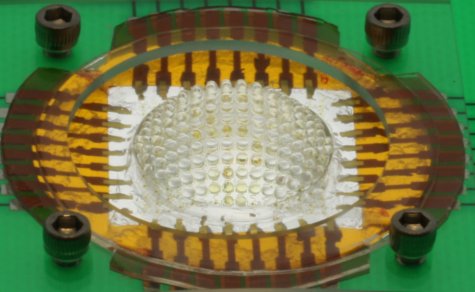
This is one of the digital cameras inspired by the design of arthropod eyes (Click for credit.)
There are two basic designs for animal eyes: “simple” eyes and compound eyes. Your eyes are called “simple” eyes, because each has only one lens. The lens focuses light that enters your eye onto a layer of tissue called the retina, which has light-sensitive cells. Those cells detect the light and send electrical impulses to your brain, which then produces an image of what the eye is seeing. In contrast, many arthropods (a broad class of animals including insects, crustaceans, spiders, etc.) have compound eyes. Each compound eye has many lenses, and each lens focuses light onto its own set of light-sensitive cells. The brain then collects the information from each of these optical units (called ommatidia) and produces a composite image.
Each eye design has its own strengths and its own weaknesses. A simple eye produces a very sharp image of whatever the lens is focused on. However, the farther anything is from the center of a simple eye’s vision, the more distorted it becomes. In addition, a simple eye has a narrow depth of field. When it focuses on an object, other things in the field of view are blurry if their distance from the eye is much different from the object being focused on. The compound eye, on the other hand, does not produce very sharp images. However, because its lenses are so small, there is very little distortion of objects that are away from the center of the eye’s view. In addition, the small lenses have a nearly infinite depth of field – objects stay in focus whether they are near or far from the eye.
The practical upshot is that compound eyes tend to be very valuable if you want a wide, panoramic view. In addition, they are very sensitive to motion. If you’ve ever tried to swat a fly, you understand that. The fly seems to see your hand no matter how slowly you move it or where you are relative to the fly. Simple eyes, on the other hand, are more valuable if you want very a very sharp, clear image of what you are focused on. So far, the cameras produced by human science and technology have been modeled after simple eyes. They give sharp, clear images of what the camera focuses on, but the view is not panoramic and the depth of field is narrow.
Dawn when she was 18
In 1994, my wife (Kathleen) and I were taking part in our weekly small group Bible study. When the time for prayer requests came around, someone solemnly said that we should all pray for Dawn Huston. Everyone around the table (except for me) gravely nodded their heads. I asked what I thought was an obvious question: “What for?” There was a long, uncomfortable silence. Finally, someone said because her “father” (hereafter referred to as DNA-donor) was probably going to jail for what he did to her. It was clear no one wanted to say anything more on the matter, so the discussion moved on.
I couldn’t move on, however. As a teacher at a residential academy for gifted and talented students, I had worked with young men and women who had been betrayed by the ones who are supposed to love them the most. I knew the devastation a situation like that produces. I hardly knew Dawn; she was just one of the kids at church. But now she was someone else: a hurting young lady who the church family had to help.
I went to the youth pastor to learn more about the story. He didn’t give me any details about what had happened, but he made it clear that Dawn was, indeed, hurting, and her situation was not improving. The woman to whom Dawn’s DNA-donor was married was not her mother, and this woman was definitely not on Dawn’s side. While the state was trying to put the DNA-donor in jail, she was doing everything she could to keep him out of jail. In addition, the counseling was aimed at reconciling the family. It was not aimed at meeting Dawn’s needs.
I asked the youth pastor if she had been given the opportunity to talk with someone who had been through a similar situation and had, for lack of a better word, survived. The youth pastor said he didn’t know of anyone like that. Well, I did. I knew several. I arranged a meeting between Dawn and one of the most well-adjusted survivors of parental abuse that I know, a young lady named Stephanie. After their get-together, Stephanie called and told me that Dawn had to get out of the house. Stephanie was honestly afraid that Dawn would kill herself if she wasn’t moved to a loving, safe environment.
Kathleen and I discussed it. We were not interested in having children, and we had no experience or training when it came to meeting the needs of a “troubled” teenage girl. But we prayed about it, and we felt the Lord leading us to take Dawn into our home. We filed the paperwork to be her temporary guardians, and she moved in. We barely knew each other, and now she was sleeping in our spare bedroom.
This was a huge adjustment for Kathleen and me. We were “double-income, no kids” people, and we liked that. We were both committed to our church, our careers, and our volunteer work. Suddenly, we had to incorporate someone else into our lives. But you know what? We found that we loved it. We found that the Lord was blessing us through this young lady. As time went on, it became clear that this should not be a temporary thing; Dawn should be a permanent part of our family.
By this time, the DNA-donor was in jail for what he had done to her, but we still had to get him to agree to give up his parental rights so that Dawn could be our daughter. I will never understand that sick, twisted aspect of our legal system. At first, he was reluctant. However, a great man of God (who has since passed into glory) made it his mission to get Dawn’s DNA-donor to relent, and he eventually did. Our spare bedroom was then transformed into our daughter’s room.
When everything was settled, we pulled her out of school and began homeschooling her. She was not happy about being homeschooled, but she accepted it because she wanted us to be her parents. From an educational standpoint, she was the classic example of a student who had fallen through the cracks. As a result, there were serious “holes” in her education. We addressed those holes as well as we could, and she eventually graduated high school. She then went on to earn a degree in sociology from Butler University. My heart still flutters when I think of her walking into that graduation ceremony wearing her cap and gown.
When people hear that we adopted a teenager, they often ask, “Wasn’t that hard?” The answer is, “Of course!” Dawn had all sorts of emotional baggage from her previous life, and it would manifest itself in many ugly ways. In addition, Kathleen and I were completely unprepared for the task ahead of us. We had no experience as parents, but suddenly we had to become the parents of a teen whose previous childhood had been nothing short of miserable. However, the Lord tells us that we can do anything through Christ who gives us strength (Philippians 4:13).
Did we have our share of troubles? Of course! Dawn and I used to have arguments that could only be described as “epic.” I remember one specific time when I got so angry with her, the only thing I could do was leave the house in the middle of our argument and start walking around the block. Kathleen and Dawn often had a hard time relating to one another, which led to all sorts of tension and heartache. I could go on and on.
Are we glad we adopted Dawn? It is difficult to find words that are strong enough to answer that question. Just thinking about the fond memories the three of us have made together over the past 18 years fills my eyes with tears. When Dawn came into our lives, the Lord began molding our hearts around her. Now that the job is complete, I cannot imagine our life without her.
Not long ago, I read a quote that describes how I feel about adopting Dawn. As far as I can tell, its origin is unknown. I am sure it was written about someone finding his spouse, but when I read it, I immediately thought of Dawn:
And then my soul saw yours and kind of went “Oh, there you are. I’ve been looking for you.”
Dawn came into our lives when she was 15. Now she is 33. She is a happy, healthy, and successful adult. She is a fine Christian woman with a good job and a great life. From my perspective, however, here is the most important thing you need to know about her: She is my little girl.
Roy Costner IV was the valedictorian of Liberty High School in South Carolina. In honor of his achievement, he was given the opportunity to address his fellow students during commencement ceremonies. Most commencement speeches are forgettable, but his was not. It wasn’t because his speech was amazingly good. It was mediocre at best. It didn’t really follow a coherent line of thought, and a large portion of the speech consisted of “shout outs” to individual students. His speech is memorable because it was an open act of defiance against the school district.
He begins his speech with this jarring statement:
As I stand here before you, members of the school board, faculty, staff, family, friends, and fellow graduates. I first wanted to say that I turned in my speech to Miss Lynn, which….uh…she somehow seemed to approve, so obviously I didn’t do my job well enough. So we’re going to just have to use a different one.
He then ripped the “approved” speech in half, pulled out another speech, and began to read. Rather quickly, he told the audience that he is grateful for the fact that his parents led him to the Lord at a young age, and then he recited the Lord’s Prayer, which is based on Matthew 6:9-13.
Why the drama? Why the prayer? According to FOX news, the school district had been getting complaints from atheist groups about the fact that they include prayers in their school events. As a result, the school district banned prayer altogether. Costner’s speech was designed to get around that decision, and if you listen to the video above, you will see that it went over well with his classmates. I have never heard the Lord’s Prayer cheered as it was during his speech!
Now even though his speech violated the school district’s ban, it appears he is not going to suffer any consequences. A spokesperson for the district says:
The bottom line is: We’re not going to punish students for expressing their religious faiths.
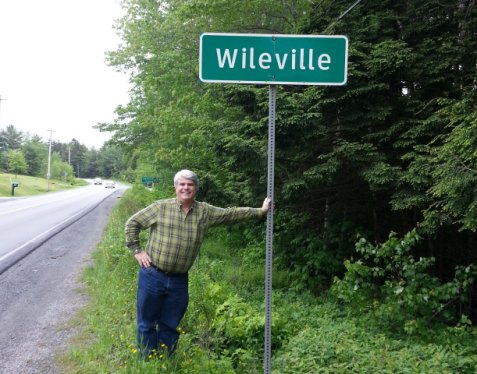
There were a lot of people named "Wile" in this town!
My Canadian tour came to a close in Nova Scotia, which actually has a place in my family’s history. My father’s ancestors came from Germany and settled there, forming a small town called “Wileville.” As you can see, I got a chance to visit there. It’s still a small town, and there wasn’t much there except for a market/bakery and a gas station. Nevertheless, it was cool to see that nearly every street was named after a Wile, and there was even a lake called “Wile’s Lake.”
Of course, the main reason I was in Nova Scotia was to speak at the HEMS Homeschool Convention. It was another intimate convention that was held at an excellent facility and run by a group of incredibly dedicated home educators. One of the things I loved about the convention was that in addition to a vendor hall (where curriculum providers sold curriculum to those who needed it), there was also a “young entrepreneurs” section where young people could sell things that they had made. There was a wide variety of things to buy, from candy to plants. I ended up buying some cards from a very talented young photographer who started a photography business called Gracious Vignettes.
I gave a total of six talks at the convention, five of which were on Saturday. That’s actually a lot of talking, and I even told the conference attendees that I expected to be bored with myself after giving so many talks. They were very gracious, however, thanking me over and over again for coming to their “little” convention. This seemed to be a theme at both of the conventions I spoke at in Canada. The organizers and even the attendees seemed to be constantly apologizing for how small their conventions were. They had heard of the mega-conventions in the U.S. and were sorry that their numbers couldn’t measure up.
I hope I was able to dispel them of this notion. I think that big conventions and small conventions both have a role to play in home education. Big conventions can bring in lots of great speakers, and their vendor halls are simply brimming with choices when it comes to educational material. However, they can’t be flexible. I remember when I spoke at the FPEA convention in May, Diana Waring and I had a great question from the audience, but before we were able to answer it, the hostess cut us off, because the convention had to stay on schedule. I completely understand why the hostess needed to do that, and it is a consequence of the convention being very large. In addition, I can’t spend a lot of time speaking with a single individual at a big convention. In both of my Canadian conventions, however, I had long discussions with several homeschoolers who needed a lot of advice, and I was never cut off in any of my talks. That’s the beauty of a small convention.
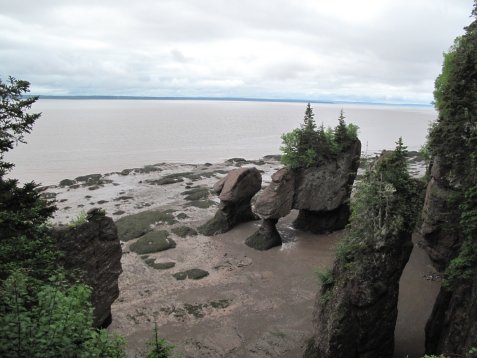
Hopewell Cape on the Bay of Fundy at low tide. (Copyright Kathleen J. Wile, all rights reserved)
If you are sick and tired of reading about the rocks at Hopewell Cape on the Bay of Fundy, I think this will be my last post about them. In my first post about my Canadian speaking trip, I showed a picture of them and briefly mentioned them. In the next post, I gave a relatively detailed account of the tides that have carved them.
In that second post, a commenter suggested that it must have taken the tides millions of years to carve the rocks into those interesting shapes. Another commenter, who is a geologist, did some digging and posted three references to geological studies of the rocks. The third one1 seemed very intriguing, so I decided to get the paper and read it for myself.
The study discussed several details regarding the rocks (which they call “stacks” and “stack-arches”), including the fact that they were most likely carved over hundreds of years, not millions.
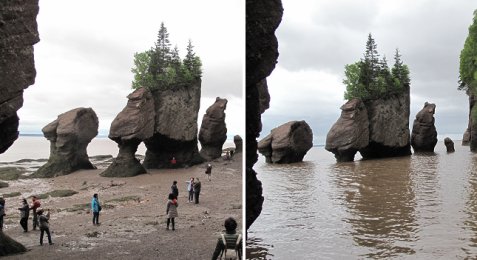
Low tide (left) and high tide (right) at Hopewell Cape in the Bay of Fundy.
(Copyright Kathleen J. Wile, all rights reserved)
As I mentioned in my previous post, my wife and I are in Canada, seeing some of the sights. Since I had read about them, I wanted to see the tides at the Bay of Fundy, which are the largest in the world. When I mentioned this to one of the organizers of the Canadian convention at which I spoke, she suggested that we go to Hopewell Cape, which has rocks that erosion has carved into some interesting shapes. She said it would be a great way to see the tides, and she was right!
On the left side of the picture above, you see some of those rocks as they appear at low tide. Notice there are several people walking around the rocks. In fact, if you look very closely, you will see a spot of red in front of the biggest rock formation. It has a white blotch above it. That’s me in my red jacket and gray hair. On the right, you see the same rock formations at high tide. There’s a big difference, isn’t there?
The Bay of Fundy experiences the largest difference between high and low tide of any place in the world. On most coastlines, the difference between high and low tide is noticeable, but not dramatic. In the Gulf of Mexico, for example, it is about 0.5 meters. On the coast of Southern Africa, it is about 1.6 meters.1 However, the difference between high tide and low tide in the Bay of Fundy can be more than 15 meters!2 That’s why the pictures above are so interesting, at least to nerds like me.
But why does the Bay of Fundy experience such incredible tides? I am glad you asked!
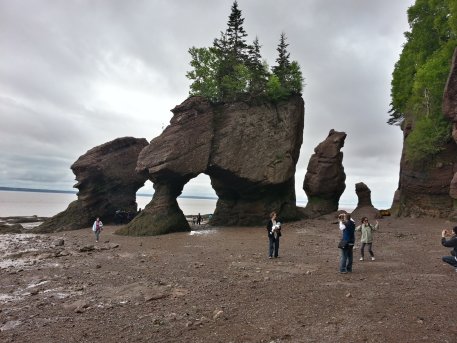
The "flowerpot rocks" formation at Hopewell Cape in the Bay of Fundy.
(Copyright Kathleen J. Wile, all rights reserved)
This past weekend, I spoke at the Home Educators of New Brunswick convention in Sussex, New Brunswick (Canada). It was an intimate, well-organized conference with many wonderful people. I spoke a total of five times, once on Friday night and four times on Saturday. Even though they are in another country, Canadians face many of the same problems with their education system that we in the U.S. face with ours. In fact, three of the talks I gave at this convention were “Canadian versions” of the talks I give here at home. They cover the same issues, but they use Canadian statistics rather than U.S. statistics. Nevertheless, the conclusions are very similar.
For example, one of my favorite talks is the one I give about homeschool graduates and what they are doing now. This link is the handout for the U.S. version of the talk, while this link is the one for the Canadian version. Even though the Canadian version contains only Canadian statistics and mostly the stories of individual Canadian homeschool graduates (with a few from the U.S. and New Zealand thrown in for good measure), you can see that the conclusions are really the same: Homeschool graduates are doing wonderfully well and are really making a difference in the world.
Of course, one of the great things about speaking at a convention in another country is that it gives you a chance to do a bit of sightseeing as well. My wife traveled up to New Brunswick after the conference was over, so she and I are traveling around enjoying the lovely countryside. The picture at the top of this post, for example, was taken at Hopewell Cape in the Bay of Fundy. I will write more about that in my next blog post.
As always, I was asked several wonderful questions after my talks and while I was in the exhibit hall.
A student sent me the video you see above. In it, a man highlights a South African geological curiosity. He says it is a giant footprint in rock that is somewhere between 200 million and 3 billion years old. He goes on to say that it is so amazing it should be drawing 20 million tourists to South Africa every year, but no one knows about it. He then takes you up a hill to the geological formation, and he shows you what appears to be a huge footprint in a wall of rock. The man points out the features of the “footprint,” and he ends the video with the statement, “There were giants on earth.”
I had the privilege of visiting South Africa in 2004. It is an amazing country, and the people there are simply marvelous. I would strongly recommend it as a vacation destination. However, I wouldn’t put this site on my “top 20” list of things you should see. While it is an interesting geological formation, it is almost certainly not a footprint.
The first problem with the idea that it is a footprint comes from the type of rock in which it is found. The man in the video says that the rock is granite. Now, I am not a geologist, so I can’t be sure that the man is right, but the rock’s appearance is consistent with it being granite. Well, granite is an intrusive, igneous rock.1 What does that mean? An intrusive rock is one that is formed underground. An igneous rock is one that is formed from molten rock, such as magma. So if this rock is granite, there is no way it could harbor a footprint. The only time a foot could have sunk into it was when its temperature was several hundred degrees, and it was below the surface of the earth!
A model of a mammoth in the Royal BC Museum of Canada (click for credit)
Mammoths are an extinct group of mammals whose fossils are found in Asia, Europe, and the Americas. As the drawing above shows, they probably looked a lot like elephants, but they had significantly more hair and long, curved tusks. Scientists have learned a lot about these animals, since they left behind plenty of well-preserved remains. Some have even been found frozen, with skin, internal organs, and even DNA preserved. Well, a find out of the New Siberian Islands might have just surpassed all other finds when it comes to preservation.
Russian scientist and head of Northeast Federal University Mammoth Museum, Semyon Grigoryev, led an expedition that was specifically looking for well-preserved mammoth remains that could possibly be used to bring mammoths back from extinction. Since parts of the permafrost in Siberia have been thawing in recent years, they believed that frozen mammoth remains might be in the process of being exposed for the first time. They thought that if they could find such remains, some of them might be well-preserved enough to contain the materials necessary for cloning, which might end up producing living mammoths!
Recent reports indicate that the team might have, indeed, made just such a find. According to news reports, the researchers found a mammoth whose lower body was encased in ice. Not frozen soil – actual ice. This resulted in remarkable preservation for that portion of the body. The team says that the muscles are pristine, and they have the red color you would expect from muscle tissue. Even more impressive, they say they have found what appears to be blood in the remains! The article linked above has a picture of tube that contains some of the liquid that the team thinks is mammoth blood. If the researchers can find living cells in the blood or any other part of the remains, they will be given to the Sooam Biotech Research Foundation for cloning in the hopes of producing live mammoths.
While this is all very exciting, I do have to add a few words of caution.